
You have probably heard it said that prompt engineering is dead. You may also have heard the opposite, that mastering the perfect prompt is the single most important skill in the AI era. Both camps are wrong, and arguing between them is a distraction from the thing that actually matters.
The prompt is not dead. But if a prompt is the most sophisticated AI thinking happening in your business right now, you are still at the foothills of what this technology can actually do for you.
What a Prompt Actually Is
A prompt is an instruction. A single input to a system that returns a single output. It is the equivalent of tapping a colleague on the shoulder and asking them one question. Useful, sometimes very useful. But not a strategy.
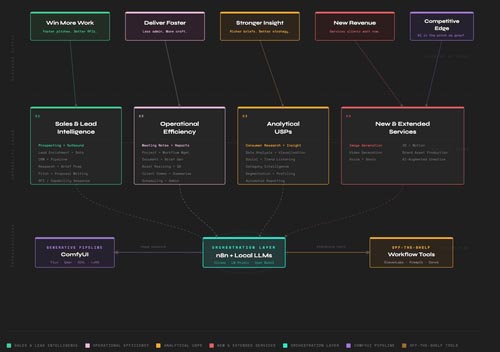
The businesses and operators pulling genuine competitive advantage from AI right now are not writing better prompts. They are building systems, structured, multi-step workflows where the prompt is one mechanism among many, often automated, often invisible, always purposeful.
Think of it this way. A prompt is a question. A workflow is a thinking process. And a thinking process, run consistently, at scale, without the overhead of a human touching every step, is a fundamentally different kind of operational asset.
The Experiment That Changed the Conversation
In 2024, AI researcher Andrew Ng presented a finding at Sequoia Capital's AI Ascent conference that quietly reframed how serious practitioners think about AI performance.
His team tested GPT-3.5 with a single prompt on a standard coding benchmark. It achieved 48% accuracy. GPT-4, a significantly more powerful and expensive model, achieved 67% on the same task with the same approach. Then they wrapped the older, cheaper GPT-3.5 in a structured agentic workflow, multiple steps, self-review, iteration, and ran it again. It achieved 95%.
A weaker model, inside a well-designed system, nearly doubled the performance of the more powerful one. As Ng put it: the improvement from GPT-3.5 to GPT-4 is dwarfed by incorporating an iterative workflow.
This is not a marginal efficiency gain. It is a structural insight. The architecture around the AI matters more than the AI itself. And most businesses have not even started thinking about the architecture.
From Prompting to Orchestration
The language is shifting because the reality is shifting. The emerging discipline is not prompt engineering. It is context engineering, the practice of designing what information, memory, tools, and instructions the model has available at every point in a workflow, so that each step produces not just an output but the right input for the next one.
Anthropic's own engineering team has written about this directly: as AI systems move toward autonomous agents operating over multiple steps and longer timeframes, the critical skill becomes managing the entire context state, not just writing a good opening instruction.
The practical difference is significant. A prompt asks a question. Context engineering designs the entire conversation, including the parts the human never has to touch.
This is the territory where real competitive advantage lives right now. Not in which AI tool you are subscribed to. Not in whether you are using GPT or Claude or Gemini. In how intelligently you have designed the system that sits around them.
What This Looks Like in a Business
The transition from prompt to system does not have to be complex to be powerful. It starts with a single question: what do you do repeatedly that follows a predictable pattern?
Every business has these processes. The weekly competitor briefing. The first-pass response to a brief. The brand compliance check on outgoing creative. The synthesis of customer feedback into insight themes. Every one of these is a candidate for a structured AI workflow, not a single prompt fired at a chatbot, but a designed sequence where each step builds on the last, where the output is reviewed, refined, and routed correctly, and where the human enters at the point their judgment is genuinely needed rather than at every mechanical step along the way.
The result is not just time saved. It is quality raised. Because a well-designed workflow does not get tired, does not skip the brief-check when it is busy, does not forget the brand guideline it was told three weeks ago. It is consistent in a way that humans operating under pressure simply cannot be.
Over 40% of enterprise agentic AI projects are expected to fail by 2027, and the primary reason cited is poor system design, not poor technology. The tools work. The thinking around them, in most organisations, does not yet match the capability on offer.
The Prompt Still Matters. Here Is Its Real Role.
None of this makes the prompt irrelevant. What it does is put the prompt in its proper place.
A well-constructed prompt, inside a well-designed workflow, is like a precisely calibrated instrument inside a great performance. It matters enormously. It needs to be right. But its quality only becomes meaningful in the context of the system around it.
The prompt sets intent. The context supplies situational awareness. The workflow delivers the outcome. Strip any one of those three things out and the whole enterprise underperforms.
What this means practically is that prompt craft is a foundational skill, not an end skill. Your team should understand how to write clear, purposeful instructions for AI systems. But the ceiling of that skill is low if it is not paired with an understanding of how those instructions slot into a broader designed process.
And here is the part most businesses have not reached yet: many of the prompts in a well-designed workflow are written once, refined over time, and never touched again by a human. They become infrastructure. The system runs them. The human steers the whole thing from above, at the level of outcomes rather than inputs.
That is a genuinely different relationship with the technology. And it is available right now to any business willing to think one level above the chat interface.
The Strategic Maturity Question
There is a version of AI adoption that looks like sophistication but is not. Twelve tool subscriptions. A team with free-trial access to everything that appeared in a LinkedIn post last week. An enterprise ChatGPT license that the board considers the AI strategy.
None of that is a strategy. It is procurement dressed as transformation.
Strategic maturity in AI looks different. It looks like understanding which repetitive, high-value processes in your business are candidates for workflow design. It looks like knowing what your AI systems are doing, why, and what guardrails are in place to ensure brand safety and quality. It looks like building infrastructure that does not have to be rebuilt every time a new model is released, because the architecture is model-agnostic and the intelligence is in the design, not the tool.
The question every leadership team should be asking right now is not "are we using AI?" It is "have we designed anything with it?"
The Challenge
Map one process your team runs repeatedly this week. Something that follows a pattern, even loosely. Ask: where does a human touch this process when what they are really doing is mechanical? Where is the genuine judgment moment where only a person who cares can make the right call?
That map is the beginning of a workflow. And that workflow, once it is built and working, is a competitive asset that compounds over time.
Chapter 3 moves into territory most businesses have not even considered yet: the case for local AI, and why the advantage hiding in your own hardware could be more significant than any subscription you are currently paying for.
NAITIV exists to demystify the AI advantage and make it real for businesses ready to lead rather than follow. If this chapter clarified something you have been circling, share it with the person in your team who is still equating AI with a chat window.